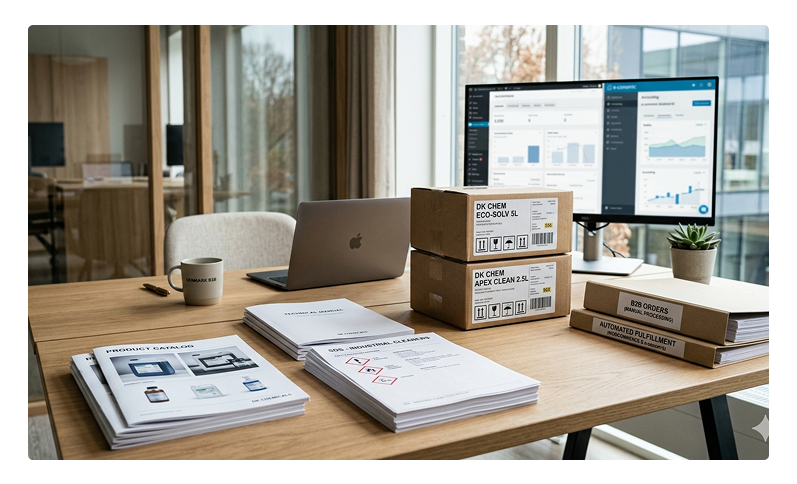
What must your webshop display when you sell chemical products online?
Do you sell chemical products, cleaning agents, paint, glue, spray products, car care products, or other items with chemical content in your webshop?
If so, there may be requirements for customers to have access to important safety information before they buy the product.
This includes, among other things, CLP data, hazard pictograms, H statements, P statements, and safety data sheets. For many webshops, the challenge is not only having the documentation—but making it visible, understandable, and up to date on the product page.
On this page, you will get an overview of the most important rules and concepts when selling chemical products online in Denmark and the EU.
If you sell hazard-labelled chemical products online, relevant hazard information must be visible to the customer.
This means the product’s safety information should not be hidden away in a folder, an old PDF, or a hard-to-access link.
As a webshop, you should pay particular attention to:
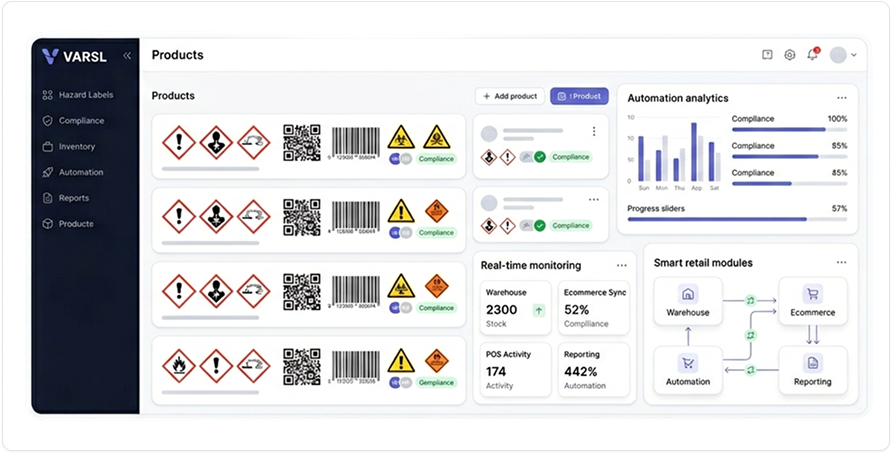
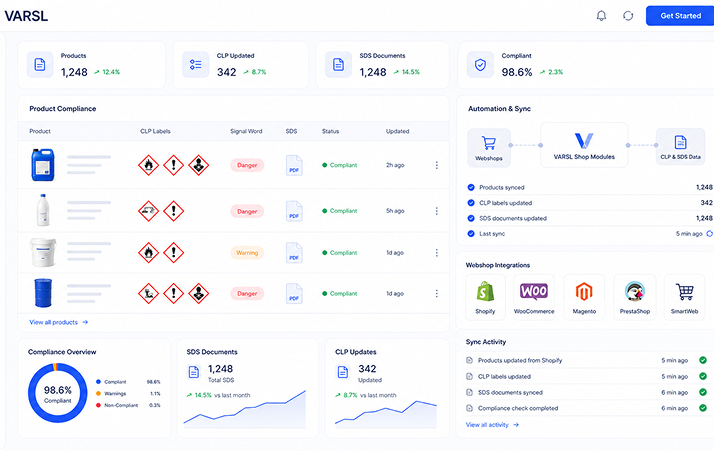
VARSL helps webshops find, collect, and display CLP data and safety data sheets directly on the product page.
CLP and SDS data are extremely important if you sell chemical products online
In Danish, CLP concerns the classification, labelling, and packaging of chemical substances and mixtures.
The purpose of CLP is to ensure that hazardous chemicals are classified and labelled in a way that users and customers can understand the hazards of the product.
CLP data may include, among other things:
For a webshop, it is important that this information is not only available in the background, but displayed where the customer sees the product.
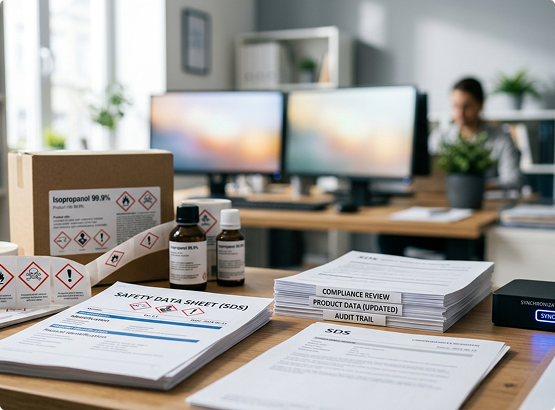
A safety data sheet (SDS) contains important information about a chemical product. This may include information about the product’s hazards, handling, storage, first aid, firefighting, disposal, and exposure control.
An SDS typically consists of 16 sections and is used to ensure that companies and users can work safely with the product.
For webshops, it is important that safety data sheets:
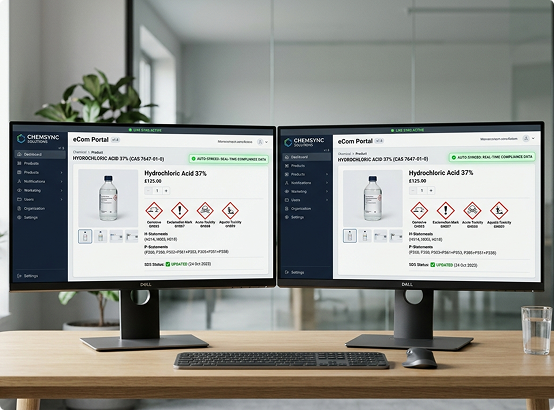
When a chemical product is sold online, the customer must be able to see relevant hazard information before the purchase is completed.
This means a webshop should treat safety information as a natural part of the product page.
Relevant information may include, among other things:
When selling to consumers, it is particularly important to note that a link to the safety data sheet is not sufficient on its own. The relevant hazard information should be visible to the customer in the webshop.
H statements are also called hazard statements.
They describe the hazards associated with the product. For example, they may relate to fire hazard, corrosion, irritation, health hazard, or environmental hazard. Examples of types of H statements include:
H statements are central because they tell the customer what makes the product hazardous.
P statements are also called precautionary statements.
They explain how the product should be handled, stored, or disposed of.
They can also describe what to do in the event of an accident, inhalation, skin contact, or contact with eyes.
Where H statements describe the hazard, P statements help explain how the user should deal with the product.
Not always.
A safety data sheet is important, but when selling hazard-labelled products to consumers, it is not sufficient to only insert a link to the safety data sheet.
The customer must be able to see relevant hazard information before the product is purchased.
Therefore, as a webshop owner, you should not only think: “Do we have an SDS?”. You should also consider these questions:
Responsibility depends on the company’s role in the supply chain.
You may, among other things, be:
As a webshop or online retailer, you should be aware that you may be responsible for ensuring that the products you sell have the required hazard labelling and relevant safety information.
If you import products from countries outside the EU, your responsibility may be greater, because in some cases you are considered the importer.
If you sell products under your own name or change information, packaging, or labelling, this may also affect your responsibility.
If you are unsure, you should contact a relevant authority or adviser.
In Denmark, relevant information and safety data sheets must be in Danish when the product is sold in Denmark.
If you sell to other EU countries, there may be requirements for the safety data sheet and relevant safety information to be available in the relevant national language.
This can quickly become complex for webshops with multiple markets.
Therefore, companies that sell across the EU should have a plan for:
Suppliers may publish new versions of safety data sheets. Product classifications may change. Rules may be updated. New markets may impose different requirements for language or display.
If safety information is handled manually, it can be difficult to spot when a PDF is outdated, or when the information on the product page no longer matches the documentation.
Therefore, ongoing maintenance is an important part of working with CLP and SDS.
Many webshops face the same challenges when selling chemical products online. Common mistakes may include:
These errors often occur because the work is manual, time-consuming, and depends on many different data sources.
Use this checklist as an initial overview.
If you are unsure about several of the points, a webshop scan can be a good place to start.
VARSL is developed for webshops that want to make CLP data and safety data sheets easier to manage.
We help find, collect, and display relevant safety information directly on the product page.
VARSL does not replace the company’s own responsibility for correct documentation, but makes the work more manageable and easier to maintain.
With VARSL, you can get help with, among other things:
Not sure which products in your webshop may require CLP data or safety data sheets?
Then you can start with a free webshop scan.
VARSL scans your webshop and displays up to 20 identified products in the customer portal.
The scan is completely non-binding.
You do not need a credit card. You do not start a subscription. There is nothing you need to cancel afterwards.
Once you have seen the result, you can choose whether to proceed with VARSL Self-service or VARSL Full Service.
For more information about the requirements for CLP and SDS, you can read more from relevant Danish authorities.